Wednesday, November 27, 2013

5 Stocks Under $10 Set to Soar

DELAFIELD, Wis. (Stockpickr) -- There isn't a day that goes by on Wall Street when certain stocks trading for $10 a share or less don't experience massive spikes higher. Traders savvy enough to follow the low-priced names and trade them with discipline and sound risk management are banking ridiculous coin on a regular basis.

Just take a look at some of the hot movers in the under-$10 complex from Wednesday, including Jakks Pacific (JAKK), which soared higher by 25%; Career Education (CECO), which jumped higher by 15%; Vicor (VICR), which ripped higher by 13.8%; and Immunomedics (IMMU), which spiked higher by 12.2%. You don't even have to catch the entire move in lower-priced stocks such as these to make outsized returns when trading.

One low-priced stock that recently soared higher was biopharmaceutical player Pain Therapeutics (PTIE), which I highlighted in Oct. 11's "5 Stocks Ready to Break Out" at $2.80 per share. I mentioned in that piece that shares of Pain Therapeutics had formed a major bottoming pattern, since the stock was finding buying interest each time it pulled back to around $2.50 a share. Shares of PTIE were then starting to spike higher and challenge both its 50-day and 200-day moving averages. That move was quickly pushing shares of PTIE within range of triggering a major breakout trade above some near-term overhead resistance at $3.05 a share.

Guess what happened? Shares of Pain Therapeutics didn't wait long to trigger that breakout, since the stock explode to the upside on October 17 with heavy upside volume. Then on October 22, shares of PTIE exploded again with monster upside volume, and the stock hit an intraday high of $4.24 a share. That represents a monster gain of over 50% in just two weeks for anyone who bought this stock and played the technical breakout.

Low-priced stocks are something that I tweet about on a regular basis. I frequently flag high-probability setups, breakout candidates and low-priced stocks that are acting technically bullish. I like to hunt for low-priced stocks that are showing bullish price and volume trends, since that increases the probability of those stocks heading higher. These setups often produce monster moves higher in very short time frames.

I'm not as eager to recommend investing long-term in stocks that trade less than $10 a share because these names can be very speculative, and the odds for picking the long-term winners aren't great. But I definitely love to trade stocks that are priced below $10. I like to view them as a trading vehicle with lots of volatility and lots of upside when the trade is timed right.

When I trade under-$10 names, I do it almost entirely based off of the charts and technical analysis. I also like to find under-$10 names with a catalyst, but that's secondary to the chart and volume patterns.

With that in mind, here's a look at several under-$10 stocks that look poised to potentially trade higher from current levels.

Ariad Pharmaceuticals

One under-$10 biopharmaceutical player that's just starting to enter breakout territory is Ariad Pharmaceuticals (ARIA), which is engaged in the discovery and development of breakthrough medicines to treat cancers by regulating cell signaling with small molecules. This stock has been crushed by the sellers so far in 2013, with shares down huge by 82%.

If you take a look at the chart for Ariad Pharmaceuticals, you'll notice that this stock has gapped down big over the last month, with the first gap sending the stock from around $19 to $4 a share with massive downside volume. The second gap sent ARIA from $4.50 to its recent low of $2.62 a share with big downside volume. Since hitting that $2.62 low, shares of ARIA have now started to rebound off oversold territory, since its current relative strength index reading is 17.92. That move is starting to push shares of ARIA into breakout territory, since the stock is flirting with some near-term overhead resistance at $3.27 today.

Traders should now look for long-biased trades in ARIA if it manages to take out some near-term overhead resistance at $3.27 and once it clears Thursday's intraday high of $3.38 a share with high volume. Look for a sustained move or close above those levels with volume that hits near or above its three-month average action of 8.03 million shares. If we get that move soon, then ARIA will set up to re-fill some of that second gap down zone that started at $4.53 a share. Shares of ARIA could easily tag its next major overhead resistance level at $5.98 a share if that gap gets filled with strong upside volume flows.

Traders can look to buy ARIA off any weakness to anticipate that breakout and simply use a stop that sits right below some key near-term support at $3.01 a share. One can also buy ARIA off strength once it clears those resistance levels with volume and then simply use a stop that sits a comfortable percentage from your entry point.

Merge Healthcare

Another stock that's starting to move within range of triggering a breakout trade is Merge Healthcare (MRGE), which develops software solutions that facilitate the sharing of images to create a more effective and efficient electronic health care experience for patients and physicians. This stock hasn't done much in 2013, with shares up just over 8% so far.

If you take a look at the chart for Merge Healthcare, you'll notice that this stock has been trending sideways since it gapped down in August, with shares moving between $2.35 on the downside and $2.98 on the upside. Shares of MRGE are now starting to trend back above its 50-day moving average of $2.65 a share. That move is quickly pushing the stock within range of triggering a big breakout trade above the upper end of its sideways trading chart pattern.

Market players should now look for long-biased trades in MRGE if it manages to break out above some near-term overhead resistance levels at $2.82 to $2.98 a share, and then once it takes out its 200-day moving average at $3.08 and its gap down day high of $3.20 a share with high volume. Look for a sustained move or close above those levels with volume that hits near or above its three-month average action o 793,997 shares. If we get that move soon, then MRGE will set up to re-fill some of its previous gap down zone from August that started at $4.60 a share.

Traders can look to buy MRGE off any weakness to anticipate that breakout and simply use a stop that sits right below some key near-term support levels at $2.55 to $2.54 a share, or below that recent low of $2.35 a share. One can also buy MRGE off strength once it clears those breakout levels with volume and then simply use a stop that sits a comfortable percentage from your entry point.

Tower Group International

One under-$10 financial player that's starting to trend within range of triggering a near-term breakout trade is Tower Group International (TWGP), which underwrites insurance and reinsurance products in Bermuda, the U.S., and London markets. This stock has been destroyed by the bears so far in 2013, with shares off huge by 77%.

If you take a look at the chart for Tower Group International, you'll notice that this stock has been downtrending badly over the last three months, with shares plunging lower from its high of $22.04 to its recent low of $3.71 a share. During that downtrend, shares of TWGP have been consistently making lower highs and lower lows, which is bearish technical price action. That said, shares of TWGP have recently formed a double bottom chart pattern at $3.71 to $3.75 a share, and it's starting to move within range of triggering a near-term breakout trade.

Traders should now look for long-biased trades in TWGP if it manages to break out above some near-term overhead resistance at $4.05 a share with high volume. Look for a sustained move or close above that level with volume that hits near or above its three-month average action of 2.51 million shares. If that breakout triggers soon, then TWGP will set up to re-test or possibly take out its next major overhead resistance levels at $4.53 to $4.54 a share. Any high-volume move above those levels will then give TWGP a chance to trend well north of $5 a share.

Traders can look to buy TWGP off any weakness to anticipate that breakout and simply use a stop that sits right below those double bottom support areas at $3.75 to $3.71 a share. One can also buy TWGP off strength once it clears resistance at $4.05 a share with volume and then simply use a stop that sits a comfortable percentage from your entry point.

Wendy's
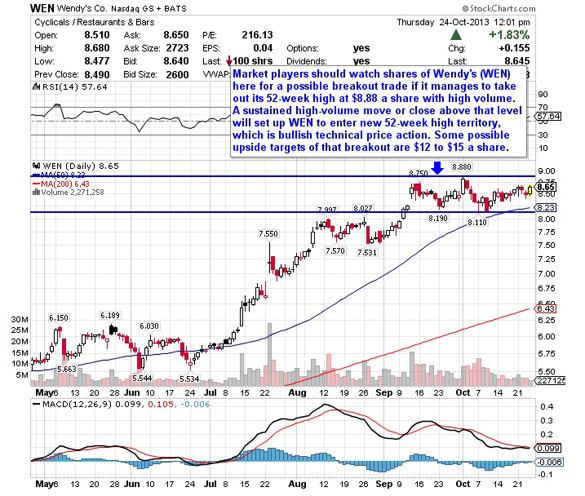
Another under-$10 stock that's starting to move within range of triggering a major breakout trade is Wendy's (WEN), which operates quick-service restaurants specializing in hamburger sandwiches throughout the U.S. This stock has been on fire so far in 2013, with shares up sharply by 57%.

If you take a look at the chart for Wendy's, you'll notice that this stock has been trending sideways and consolidating for the last two months, with shares moving between $8.11 on the downside and $8.88 on the upside. This consolidation has been occurring just above WEN's 50-day moving average of $8.23 a share. Shares of WEN are now starting to spike higher and move within range of triggering a major breakout trade above the upper-end of its recent range.

Market players should now look for long-biased trades in WEN if it manages to break out above its 52-week high at $8.88 a share with high volume. Look for a sustained move or close above that level with volume that hits near or above its three-month average action of 6.61 million shares. If that breakout hits soon, then WEN will set up to enter new 52-week-high territory, which is bullish technical price action. Some possible upside targets of that breakout are $12 to $15 a share.

Traders can look to buy WEN off weakness to anticipate that breakout and simply use a stop that sits right below its 50-day moving average at $8.23 a share, or below more support at $8.11 a share. One can also buy WEN off strength once it clears its 52-week high at $8.88 a share with volume and then simply use a stop that sits a comfortable percentage from your entry point.

Noranda Aluminum

One final under-$10 stock that looks poised for higher prices is Noranda Aluminum (NOR), a North American integrated producer of value-added primary aluminum products and high-quality rolled aluminum coils. This stock has been hammered by the sellers, since shares of are off sharply by 54% so far in 2013.

If you take a look at the chart for Noranda Aluminum, you'll notice that this stock has been downtrending badly for the last five months, with shares plunging lower from its high of $4.23 to its recent low of $2.21 a share. During that downtrend, shares of NOR have been consistently making lower highs and lower lows, which is bearish technical price action. That said, shares of NOR have recently started to rebound off that $2.21 low, and the stock has pushed back above its 50-day moving average of $2.66 a share. That move is quickly pushing the stock within range of triggering a near-term breakout trade.

Traders should now look for long-biased trades in NOR if it manages to break out above some near-term overhead resistance at $2.82 a share with high volume. Look for a sustained move or close above that level with volume that hits near or above its three-month average action of 442,823 shares. If that breakout triggers soon, then NOR will set up to re-test or possibly take out its next major overhead resistance levels at $3.20 to $3.48 a share. Any high-volume move above those levels will then give NOR a chance to tag its 200-day moving average at $3.80 a share.

Traders can look to buy NOR off weakness to anticipate that breakout and simply use a stop that sits right below some near-term support levels at $2.55 to $2.40 a share. One can also buy NOR off strength once it clears $2.82 a share with volume and then simply use a stop that sits a comfortable percentage from your entry point.

To see more hot under-$10 equities, check out the Stocks Under $10 Setting Up to Explode portfolio on Stockpickr.

-- Written by Roberto Pedone in Delafield, Wis.

Should You Shop on Thanksgiving?

Top 5 Tech Stocks For 2014

Major Retailers Begin Black Friday Sales ThanksgivingTasos Katopodis/Getty ImagesKmart is just one of several major retailers opening on Thanksgiving to the dismay of worker advocates and some consumers. A lot has been made about the fact that several major retailers will be opening their doors on Thanksgiving to holiday shoppers. Many have complained that this special day should be reserved for family -- not shopping. Facebook (FB) pages have popped up encouraging people to boycott Thanksgiving Day sales. And petitions have been started on Change.org to stop stores from opening on Thursday. Yet, more than one-third of consumers said they are certain that they will shop at Thanksgiving sales, according to a Georgetown Institute for Consumer Research survey. And a RetailMeNot.com survey found that about 20 percent of consumers said that Thanksgiving sales will give people a fun family activity to do on that day and will give shoppers who have to work on Black Friday the opportunity to get great deals. So, clearly, there are differences of opinion. If you're on the fence, though, here are several things you should consider:

Tuesday, November 26, 2013

Test Drive: Toyota Corolla a refined fuel sipper

Toyota left little recognizable when it overhauled the Corolla compact.

The 2014 model, on sale since September, now is made in Tupelo, Miss., instead of Canada.

It has a new menu of transmissions and a new high-mpg Eco version of the carryover four-cylinder engine with increased horsepower (140 vs. 132 for other models) and a laudable 35 mpg government rating in combined city/highway driving.

The wheelbase is 3.9 inches longer, and it mostly went to extending rear seat legroom. Trunk got a bit bigger, too. Overall, the car's 2.6 inches longer and half-an-inch wider. Still solidly compact, but feels bigger than that inside.

Not sporty, though. The TV ads portray some growl from the engine and a bit of agility that could make you believe Toyota's made a little BMW, but not so.

In real life, the engine growls because the new continuously-variable-ratio automatic transmission (CVT) forces it to rev high and struggle to accelerate. In fact, it's pretty much dead under full throttle from a full stop. Once underway, the setup's more responsive.

Corolla S models have manual-shift mode that makes it more fun, and a "sport" mode that changes the transmission to create seven ratios as in a normal transmission instead of the continuously changing ratio of a CVT. That setting does improve response, as well as driver satisfaction.

"Sport" holds the transmission in each gear long enough for the engine to really stretch its legs under full throttle. It's still closer to dead than alive when you floor the gas from a dead stop, though.

It'd make you nervous jumping from a side road onto a main road with fast-moving traffic and little space between cars.

Those references to dead-in-the-water initial response from a standstill might provoke an argument from Toyota engineers, who tried to make this CVT responsive. Toyota's hybrids all have had CVTs, but those have used gears. The Corolla CVT is Toyota's first use of the more common belt-drive CVT in the U.S.

Two ot! her transmissions are offered, a four-speed automatic, as in the previous model and only on the base L, and a six-speed manual replacing last year's five-speed.

The suspension type and layout remain the same as in the old version, which means the 2014 leans in sharp corners, with enough understeer to get the driver's attention. Dramatic, tire-squealing understeer in some cases.

If you like tossing the car around a little, Corolla's not the compact sedan for you. You're better off with a Honda Civic or, most particularly, a Ford Focus. The Ford, while perhaps not the best overall value among compacts, has a terrific chassis.

The new Corolla shines inside. New dashboard is a broad horizontal sweep that gives the illusion of greater width inside. And it's festooned with enough of the cheap but acceptable plastic trim items, such as a thin faux wood strip in the LE Eco test car and thin blue line in the S test car, to have a pleasing overall feel.

Toyota did not make the mistake that Honda did on the redesigned 2012 Civic, with its underwhelming interior that required a fast makeover for the 2013 Civic.

Nor did Toyota make the Civic 2012 misstep in refinement. The Corolla is quiet and serene inside, at least compared with others of its ilk. So's the Civic — now.

Seats are comfortable both front and rear, and the expanded leg and knee room in back will be welcomed by those who ride there.

Fuel economy will be a selling point. Not only are the published ratings alluring — as much as 42 mpg on the highway in the Eco version — but they are surprisingly realistic. Test Drive tends to drive 'em like we stole 'em, so usually registers fuel economy numbers well below the window-sticker ratings. Not so in the Corolla test cars.

The Eco model, pushed briskly through hilly terrain, was good for 39 mpg. The S, keeping the transmission in the fuel-using but fun enhancing "sport" mode and using any excuse to floor the gas, was good for 35 mpg in hilly terrain.

M! ost of th! e newest-generation compacts can get 30 mpg or better driven normally, but to exceed 30 by so much, without trying, is impressive.

If the Corolla as a package wows you, but you enjoy spirited driving, try the S model with "sport" and manual-shift capability. And don't demand too much when you happen on the right street at the wrong moment and have to make a sudden 90-degree turn.

If you're smitten by the new features, roomier interior and good mpg, and don't drive hard, especially around corners, the redone 2014 Corolla seems an excellent choice.

TOYOTA COROLLA DETAILS

What? Redesign of four-door front-drive compact sedan that's one of the best-selling cars in the world, passing 40 million lifetime sales in July.

When? On sale since September

Where? Made at Tupelo, Miss.

How much? Starts at $17,610 for base L with six-speed manual transmission, including $810 shipping; $20,910 for test LE Eco Premium with CVT (continuously variable-ratio automatic transmission); $23,570 for S Premium.

What makes it go? 1.8-liter four-cylinder gasoline engine rated 132 horsepower at 6,000 rpm, 128 pounds-feet of torque at 4,400 is carried over from 2013. New Eco fuel-economy model uses same engine, new valve technology and is rated 140 hp at 6,100 rpm, 126 lbs.-ft. at 4,000 rpm.

Three transmissions are available, depending on model: four-speed automatic (base L only), six-speed manual, CVT continuously variable automatic.

How big? About 3 in. longer than a Honda Civic. Slightly longer, wider than previous Corolla, about 6% more passenger space. Trunk is 13 cubic feet, up from 12.3 cu. ft.

Weighs 2,800 to 2,865 lbs.

Turning circle diameter, 35.6 ft.

How thirsty? Depending on transmission, models are rated 27 to 30 mpg in the city, 36 to 42 highway, 31 to 35 combined city/highway. Eco model has highest rating in each.

Eco test car with CVT driven briskly in hilly terrain registered 39 mpg (2.5! 6 gallons! per 100 miles). S test car with CVT mostly in "sport" mode and using lots of wide-open throttle bursts in hilly terrain delivered 35 mpg (2.86 gal./100 mi.). The mpg numbers aren't rounded, they just happened to come out even.

Burns regular, holds 13.2 gallons.

Overall: Nicer, more fuel-efficient, roomier than predecessor.

Monday, November 25, 2013

Tesla Is The New Bubble Stock

If it looks like a bubble and acts like a bubble, it's a bubble.

Tesla Motors (TSLA) is the new bubble stock.

There is a lot of money to be made and lost in a bubble stock, but the trouble is bubble stocks are for trading not investing.

Once a bubble is underway almost anything can happen in the short term, but in the long term the outcome of a return to market normality is extremely likely. That doesn't mean you can't make a lot of money out of the madness, it's just a very dangerous game.

Risk equals reward and bubbles are immensely risky, which is why there is reward to be had. As such, bubble stocks draw investors to them like the clichéd moths to a flame.

Bubbles are lovely to behold. Look at this delightful chart:

Let's go closer. Fascinating. What's that burning smell? Wow it's me!

Of course the best thing to do is ignore these kinds of stocks but that sadly is not going to happen. The reason TSLA has gone to the moon–shares are up more than 500% over the last 12 months–is everyone wants in. Saying "avoid" is futile.

Saying Tesla's stock price is too high is not the same as saying Tesla is not a brilliant company. Tesla has done a great job. The stock isn't through the roof for nothing. You just have to see one of its cars on the road to want to own it. It is so "lick-able" it looks like an iPhone with wheels.

What did they do to the paint job to give it that opalescence? Or is that the new owners just polish it 24/7? Who knows, we shouldn't care. Perception can only be reality for so long.

We should stick to the land of comparative valuations and likely outcomes. So Tesla is a great company with a great product, but is it a good value investment? Let's keep that for later, but you can guess right off what my opinion is: no it isn't.

Is its stock going to rise? Why not? Once "superstar" status is achieved normal laws of the market no longer apply.

If Tesla wasn't a superstar stock it would be the easiest call in the world to short Tesla, but with the U.S. market's bi-polar tendencies, this is the first thing to avoid doing at this stage. There is always plenty of time to short Tesla and it will be a long time after it made perfect sense to do so. Superstar stocks can stay in orbit a lot longer than you'd ever guess.

So go long? Going long Tesla is purely a trading position, there is no long-term reason to cling onto this company at these heady valuations. Not unless TSLA invents anti-gravity paint.

I know no one wants to hear this but Tesla is worth twice Fiat, the owners of Ferrari.  Tesla and Porsche are worth about the same. You could buy Peugeot Peugeot five times over. Should Tesla be worth half of GM? The market thinks so and the market is always correct. Right?

Special Offer: Get the names of five rock–solid companies with real, tangible growth drivers and big money making potential in the free report 5 Bargain Stocks To Buy Now.

So how to play the stock? Well first off, if you aren't in, leave this one alone unless you want to play a high risk gambling game with your money. Tesla is now pure speculation.

Friday, November 22, 2013

Foot Locker (FL) Scores in the Third Quarter

NEW YORK (TheStreet) -- Retail might be having a hard time of it, with earnings disappointments Sears (SHLD), GAP (GPS), and Dollar Tree  (DLTR), but outlier, Foot Locker (FL), managed to walk all over the competition in its most recent quarter.

The athletic retailer reported third-quarter adjusted earnings of 68 cents a share, 2 cents higher than analysts surveyed by Thomson Reuters were expecting. Revenue of $1.62 billion was 6.4% higher than the year-ago quarter and exceeded consensus by $50 million.

10 Best Stocks To Invest In 2014

Comparable-store sales were up 4.1%, a considerable boost from the second quarter's 1.8% gain. As of Nov. 2, the company's merchandise inventory totaled $1,316 million, 6% more than its value at the close of the third quarter 2012.

Since February, Foot Locker has consolidated its U.S.-based stores, reducing the number of store fronts by 16, while increasing international storefronts by 208. In the 12 months from October 2012, the New York-based apparel store has increased its total store count by 4.2% to 3,510 corporately operated stores.  "The team at Foot Locker, Inc. is continuing to identify new opportunities and develop ideas further in order to leverage our strengths and build an even stronger business. Some of these ideas deliver immediate impact, some will help improve results in the next several quarters, and yet others have the potential to drive our performance over the longer term," said CEO Ken C. Hicks in a statement. In premarket trading, shares had kicked 3.5% higher to $38.05. Year to date, the stock is up 14.5%, shy of the S&P 500's 25.92% gain. TheStreet Ratings team rates Foot Locker Inc as a Buy with a ratings score of A-. The team has this to say about its recommendation: "We rate Foot Locker Inc (FL) a BUY. This is based on the convergence of positive investment measures, which should help this stock outperform the majority of stocks that we rate. The company's strengths can be seen in multiple areas, such as its growth in earnings per share, revenue growth, largely solid financial position with reasonable debt levels by most measures, reasonable valuation levels and increase in stock price during the past year. We feel these strengths outweigh the fact that the company shows low profit margins." You can view the full analysis from the report here: FL Ratings Report

Monday, November 18, 2013

The World's 4th Biggest Economy is Finally Getting Access to Online Trading. Here's the Play. (ETFC, SCHW, IGEX, AMTD)

Ever wish you could go back in time and get in on the ground floor of online stock-trading names like Charles Schwab Corp. (NYSE:SCHW), TD Ameritrade Holding Corp. (NYSE:AMTD), or E TRADE Financial Corporation (NASDAQ:ETFC)? While all three stocks have done fairly well since debuting anywhere about 20 years ago, the lion's share of their gains came in just the first few months of their existence. SCHW rallied just shy of 400% in its first eleven months of trading. AMTD soared more than 750% during its first six months of being a publicly-traded stock. ETFC had jumped a whopping 1289% nine months after its IPO. Well, while nobody can get in a time machine and do it over, there's another online-trading company on the horizon that could be similarly potent. It's Indo Global Exchanges PteLtd (OTCMKTS:IGEX).

If you've never heard of Indo Global Exchanges PteLtd, don't worry - you're not alone. The company only came into existence (in the form we know it today) a few months ago. You'll also not likely hear about it as an investor/consumer here in North America either, so the likes of E TRADE Financial, TD Ameritrade Holding, and Charles Schwab have little to worry about in the way of new competition... yet, anyway. That's because IGEX is taking aim at the Indonesian market, bringing an impressive stock-trading platform to a country and locale that has nothing like that at all.

Top Insurance Companies To Buy For 2014

It would be easy to quickly dismiss the opportunity based on the target market alone; as solid as the brokerage and trading technology is, it's still just Indonesia, right? Point of clarification: There's no "just" anything about Indonesia. It IS not only an impressive economy, but it's also an impressive opportunity for a company like Indo Global Exchanges that can give its rapidly maturing middle class - and rapidly growing investor base - something it doesn't have, but desperately wants.

Most Americans may be surprised to learn that Indonesia is home to 250 million people. For perspective, the United States' population isn't much bigger, at 313 million. And, Indonesia is hardly the third world country many in the Western world may presume. It's the fourth largest economy in the world, and the second-fastest growing. Last year, Indonesia's GDP grew 6.2%, and is on pace to grow 6.3% this year. It's a pace the United States could be envious of.

Those 250 million people are also internet savvy too... perhaps even more so than United States' populous. Indonesia, as a country, is the biggest user of Facebook, and smartphones are becoming the norm.

It's not just the advent of technology that makes the market a prime opportunity for IGEX, however. The country's rapid economic growth has given risen to a large, solidly-affluent middle class with disposable assets that are struggling to find a capital markets home. Indo Global Exchanges PteLtd estimates there are 30 million potential customers that are immediately qualified and willing to become clients, and that number could rise to as many as 140 million if the country's economy continues to grow at its current pace and pulls more citizens into its middle class.

The bottom line is, where IGEX is now in Indonesia is where Charles Schwab Corp., TD Ameritrade Holding Corp. and E TRADE Financial were in the United States in the mid 90's. At the time, most people had a vague belief that "this online stock trading thing could take off", but nobody saw it becoming the disruptor (perhaps even the norm) for an industry that was built around a broker pitching stocks to clients over the phone. As dramatic as that paradigm shift was in North America, Indo Global Exchanges' march into the Indonesia market - where it faces virtually no competition - could be just as dramatic... and bullish.

For more on Indo Global Exchanges PteLtd, visit the SCN research page here.

Sunday, November 17, 2013

Jack Yellen Would Have Been Appointed Last Month

NEW YORK (TheStreet) -- Larry Summers has withdrawn his name as a potential candidate for Chairman of the Federal Reserve, even though he looked to be President Obama's man. Obama, despite all the negative baggage associated with this potential nominee, was likely to name him as the successor to Ben Bernanke.

This baggage included cozy Wall Street relationships, involvement with deregulation that led to much of the financial crisis and then his stepping down at Harvard due to his sexist remarks about women. Obama has already faced criticism from the female vote for his lack of appointments, especially painful since his 2012 Republican opponent Mitt Romney was seen as an enemy to female appointees.

Top 5 Tech Stocks To Watch Right Now

While someone shouldn't be appointed to a high level position just because she's a women, there are certainly qualified candidates. The president must have lost his binder full of women.

"I was one of 100 leaders that sent a letter demanding Obama not appoint Summers," said Amy Siskind, president and co-founder of the New Agenda. She points out there was pressure from many sides not to go with Summers. Even former Obama adviser Christine Romer publicly sided against Summers. Yet, Obama stubbornly stuck with him. Now that Yellen is looking like the odds on favorite, she is coming under attack. There is no doubt she is qualified. Yellen is Vice Chairwoman of the Board of Govenors of the Federal Reserve. She's been the President and CEO of the San Francisco Federal Reserve, Chair of the White House Council of Economic Advisors under President Clinton, and on and on. But some are now saying she doesn't have the gravitas for the job. Seriously? With that resume? "Lacks gravitas is code for a woman," says Siskind. "It is factually incorrect that Yellen lacks gravitas." Another criticism lobbed at Yellen is that she'll just continue Bernanke's efforts and not attempt to back out of quantitative easing. However, these programs will have to be eased out of slowly by whoever takes over for Bernanke. No one can come in with a knife and immediately slice off the easy money. There is also the belief that Obama will look weak if he picks Yellen. "If he doesn't appoint her, it will be irrational," says Siskind. There aren't any other contenders. Tim Geithner said he didn't want the job. None of the other names floated around seemed to be taken seriously by the White House. So, it looks like it will be Yellen, but the female voters that helped put Obama in the office will not forget this slight. They had to fight against a man with a history of sexist comments versus a woman who was vastly more qualified. "If her name had been Jack Yellen, she would have been appointed last month," said Siskind. Sadly Amy, that is probably true. --Written by Debra Borchardt in New York. >To contact the writer of this article, click here: Debra Borchardt. Follow @WallandBroad

Saturday, November 16, 2013

Will Boeing Continue to Soar?

Although Boeing (NYSE: BA) had its early problems with the new 787-Dreamliner, there has certainly been nothing wrong with the performance of the company's stock.

For 2013, Boeing has soared by over 80 percent to around $135 a share. But there could even more growth ahead, as Mark Kingdon, of Kingdon Capital Management, sees Boeing at almost $170 a share.

Speaking at the recent "Invest for Kids" conference in Chicago, Kingdon was bullish on Boeing, the largest U.S. exporter by dollar value, for a variety of factors both micro and macro.

Top 10 Value Stocks To Buy For 2014

For the macro conditions, Kingdon is "generally positive" on both equities and the global economy. He is pleased by the changes taking place in Japan and China. That scenario is also bullish for Boeing, as both China and Japan are major players in air travel.

As for Boeing itself, its management and position in the industry is very impressive. The 787 is turning out to be a fine plane with a pleasing customer experience. Due to its fuel savings, the 787 pays for itself in a relatively short period of time.

At present, the biggest customer for the 787 is United Continental (NYSE: UAL). Demand for the 787 is particularly strong from Asia, with an eight-year backlog.

The newest version of the twin-engine, medium range 737 has been selling well, too. That is the plane used by Southwest Airlines (NYSE: LUV) for its mid-range routes in the United States. It has always been the backbone of the air fleet for Southwest, the only American carrier never to file for bankruptcy. The plane is also ideal for expanding regional urban areas across Asia, too.

Kingdon projects free cash flow doubling in the next two years for Boeing.

Based on 14 times cash flow, Boeing should be at $168 a share. What makes that even more appealing to shareholders is the company's management has pledged to return 80 percent of the free cash flow to shareholders in dividends and buybacks.

At present, the dividend yield for Boeing is 1.46 percent. The payout ratio is very low at only 20.40 percent, so there is plenty of cash to increase the dividend or fund stock buybacks. The five-year dividend growth rate has been 2.75 percent.

A Dow 30 stock, the primacy of Boeing in its industry can be seen by the share price being up for the past week, month, quarter, six months, and year of market action. Much of that can be attributed to the success of the 787. With an eight-year backlog and demand strong from Asia, the share price for Boeing should be headed higher.

Posted-In: Airline Industry airlines airplanes aviation China Japan Mark Kingdon transportationLong Ideas News Emerging Markets Dividends Travel Global Markets Trading Ideas General Best of Benzinga

(c) 2013 Benzinga.com. Benzinga does not provide investment advice. All rights reserved.

  Around the Web, We're Loving... Come Learn 6 Proven Trading Strategies at Our Holliday Trading Summit Learn to Use Trading Platforms Like Hedge Fund Traders do Rumsfeld: Denial of Benefits to Fallen Soldiers' Families 'Inexcusable' Come See How the Pro's Trade in this Exclusive Webinar Facebook, Baidu Lead Big Caps Beating Shutdown What Should You Know About AMZN? Most Popular General Electric to Spin-Off Retail Finance Unit in an IPO 3 Reasons Every Family Office Should Own Oil and Natural Gas Stocks 10 Stocks Below Their 50-Day Moving Average Apple Breaks Out of Six Day Trading Range Benzinga's Top #PreMarket Gainers 6 Ways to Tell if the Market is About to Crash Related Articles (BA + LUV) Boeing Flight Services Miami Engineers Vote to Join SPEEA, IFPTE Local 2001 Will Boeing Continue to Soar? Buy Illinois Stocks, Not Chicago Bonds Union Vote Means 777X May Not Be Built in Washington State US Stock Futures Mixed Ahead of Economic Data Boeing Statement on IAM Voting Down Contract Extension View the discussion thread. Partner Network #marketfy-ae-block { display: none; border: 2px solid #0a3f75; overflow: hidden; width: 300px; height: 125px; text-align: center; background-color: #45719E; position: relative; z-index: 1; } #marketfy-ae-block a { display: block; width: 300px; height: 125px; position: relative; z-index: 2; color: #ffffff; text-decoration: none; } #marketfy-ae-block-countdown-text { color: #f9fc99; padding: 0px 0 0 0; font-size: 19px; font-weight: bold; line-height: 19px; } #marketfy-ae-block-countdown-text-start { font-size: 12px; } #marketfy-ae-block-countdown { padding: 5px 0 5px 0; font-size: 26px; } #marketfy-ae-block-signup { padding: 5px 47px; } #marketfy-ae-block-signup:hover { background-color: #457a1a; } #marketfy-ae-block #marketfy-ae-block-logo { display: block; padding: 3px 0 0 0; margin: 0; } #marketfy-ae-block-logo { text-indent: -9999px; } #marketfy-ae-block-free { display: block; position: absolute; top: 7px; right: -23px; width: 80px; height: 16px; line-height: 16px; text-align: center; opacity: 1; -webkit-transform: rotate(45deg); -moz-transform: rotate(45deg); -ms-transform: rotate(45deg); transform: rotate(45deg); font-size: 13px; font-weight: normal; color: #333333; background-color: yellow; z-index: 500; text-shadow: 1px 1px #999999; } #marketfy-ae-block-arrow { position: relative; width: 60px; height: 60px; z-index: 10; margin: -80px 0 13px -21px; } #marketfy-ae-block-arrow img { height: 60px; width: auto; } Marketfy's International
Traders & Investors Summit Register for this FREE Event! Hosted by Marketfy

Friday, November 15, 2013

Smart Money Bets Big on Small Banks

RSS Logo Tim Melvin Popular Posts: 2 Cheap Bank Stocks to Buy Now3 Stocks Backed by 80 Years of Investing Know-How9 Stocks Getting Dumped by Fund Managers Recent Posts: Smart Money Bets Big on Small Banks The Price is Right for These Smart Money Moves 9 Stocks Getting Dumped by Fund Managers View All Posts

A few weeks ago I wrote about activist investors and their increased activity in the banking sector. One of the investors I talked about was Joseph Stilwell, an investor who has been successful with small banks for a long time. He's taken a stake of at least 5% in almost 50 such stocks and has successfully pressured for a sale at a higher price in many of these small banks.

Well, Stilwell's 13F filing showing his holdings at the end of the third quarter is out now, and we can see what he has been up to in small bank stocks.

It was a quiet period for Stilwell's finds, as many bank stocks rose more than the market and there were not as many attractive entry points as earlier on the year. But he did buy a few stocks worth mentioning.

He opened a position in shares of Banc of California (BANC) in the quarter. The company is the holding company for Pacific Trust Bank and Beach Business Bank in the San Diego area. The bank has 60 locations and more than $3.5 billion in assets, and it just completed the acquisition of three institutions — The Private Bank of California, The Palisades Group and CS Financial –  which increased total assets by almost $1 billion. The shares trade right at book value. Banc of California is well positioned to benefit from a strong recovery in California and may eventually become a buyout target itself.

Stilwell's funds also bought more shares of Peoples Bancorp of North Carolina (PEBK). The bank operates in central North Carolina and has 22 branches with a little over $1 billion in assets. PEBK just reported a solid quarter, increasing earnings by more than 40% year-over-year while working down nonperforming assets by 30%. The bank also grew its deposit base in the quarter — a difficult accomplishment for many small banks this year.

5 Best Undervalued Stocks To Own Right Now

North Carolina is one of the more attractive markets in the country, and most analysts expect a substantial amount of merger and acquisition activity in the state. Peoples Bancorp could be a very attractive target for a larger bank looking to expand in the region. The stock currently trades for less than 90% of book value, so there's a lot of upside potential in the shares.

Stilwell also added to a couple of his microcap banks in the quarter, but all in all it was a very quiet summer for the longtime bank activist. If you are not already heavily involved in the trade of the decade, use his holdings as a good place to search for small bank ideas.

At the time of publication, Melvin had no positions in the securities mentioned.

Thursday, November 14, 2013

How to Buy Amazon, Priceline and Limit Downside Risk

New York (The Street) -- If you've owned Amazon (AMZN) or Priceline.com (PCLN) for at least a year, you're probably feeling very good. With Priceline hitting a new 52-week high on Wednesday at $1,126.76 a share, your original investment capital has nearly doubled, and if you've owned Amazon, you're ahead by over 62%.

Now's a smart time to protect your gains, wouldn't you say? How do you accomplish this without spending a fortune? If you believe in using options as downside "insurance" you can buy a "mini" put contract for every 10 shares that you own and choose a "strike price" just below the current stock price level.

Another strategy to protect your gains is to set a trailing stop-loss order that will convert to a market order if shares of Amazon or Priceline fall a specific percentage or dollar amount that you've established in your trailing stop loss order. For example, if you set a 25% trailing stop loss percentage, when the shares fall 25% from the highest price level it attains from the moment you've placed the order, you're brokerage will automatically sell your shares.

The problem with this approach is that when you place any kind of stop-loss or a sell-limit order with your brokerage firm, you're in essence telling the exchange that these stocks trade on that you're "willing" to sell if the shares fall to the level you've chosen in your order. With high-frequency trading programs and algorithms that search for groups of sell orders (and essentially that's what a trailing stop loss order is, a sell order), you might find yourself the victim of a mini-flash-crash.

A mini-flash-crash is precipitated by a trading program or a group of computer trading programs that can temporarily drive the price down to where a large amount of sell orders currently exist. When the price momentarily drops these sell orders are converted to market orders and your shares are sold. Then the market-makers assigned to Amazon or Priceline fill any or all buy-limit orders that happ! en to be at the same price level.

The outcome is you've sold low and somebody or some fund has had the pleasure of buying low. That's why I think it is better for the smaller, individual investor to use a trailing stop loss alert system that the market-makers and the exchanges can't see. There are optimal trailing stop loss percentages for each stock that helps you to stay invested during volatile market conditions and follows the stock higher as it reaches for the stars.

Hot Low Price Companies For 2014


                                                What If You Don't Already Own Amazon or Priceline.com?

First of all, be sure you want to own these companies. Amazon sells at dizzying PE ratios because the investment community sees it as a play on skyrocketing revenues, like the extra revenues Amazon should experience from its new service through the U.S. Postal Service that offers delivery of what was purchased on Sundays. Jeff Bezos and his team have an impressive track record of lucrative innovations and this one is no exception.

Priceline.com is selling for around 22 times forward earnings or a 1-year forward PE ratio of 22. That sounds very expensive compared to Microsoft (MSFT) but if you compare how the stock of each has performed you clearly see investors prefer Priceline.

You can buy a mini-call option on both Amazon and Priceline and at the same time sell a mini-put option at the same strike price. Make sure the expiration dates on these mini option contracts go out far enough into the future so you have a better chance of seeing the call go up in price while the put you sold hopefully drops in value.

Some investors call this strategy a "synthetic long", and it's designed to let an investor or trader participate in the upside potential without committing a big chunk of your investment money. You can set up a trailing stop alert for Amazon and Priceline to help you stay focused that the underlying stock price is heading the right direction.

The discipline of a trailing stop is akin to the discipline of position sizing. Both are risk management strategies that are designed to prevent catastrophic losses while giving investors a fighting chance of experiencing some big winners.

Ask your brokerage firm about ! using mini option contracts for synthetic longs or,with mini put options, as a strategy that protects you if the stock or long-term call you own suddenly plummets in price.

Even if you just want to buy some shares of the high-priced stocks which includes Google (GOOG) use a trailing stop monitoring and alert system that lets you know at the end of each trading day how close you are to the trailing stop loss percentage or dollar amount you've chosen for each holding.

Remember, a trailing stop is a huge help in making sure you lose just a little bit when you're wrong about the direction of an investment you're buying. Yet most of us face two big problems as traders and investors: When to cut our losses short... How far to let our winners soar before taking our profits.

That's why you need a way of pegging assets to their highest price during the period you've owned it. That's precisely what a trailing stop loss accomplishes. By using trailing stop loss alerts on the stocks you buy from the time you buy them, you can keep your emotions out of your way, predetermine what an unacceptable loss is for you, and look forward to letting your winners soar before capturing your profits.

Disclosure: At the time of the publication of this article the author was long GOOG and MSFT.

Follow @m8a2r1 at https://twitter.com/m8a2r1


Marc Courtenay is the founder and owner of Advanced Investor Technologies, LLC, as well as the publisher and editor of www.ChecktheMarkets.com.

Courtenay holds a Master's of Science degree in Psychology from California Polytechnic State University, and is a former senior vice-president of Investments for two major brokerage firms. He's been a fiercely independent investment "investigator" and a consulting contributor to the investment publishing world for over 30 years. In addition to his role as an investment publisher and analyst, he serves as a marketing consultant to the investment media industries.

In his role as a financial editor, he specializes in unique investment strategies, overlooked stock investments, energy and resource companies, precious metals, emerging growth companies, the prudent use of option strategies,real estate related opportunities,wealth preservation, money-saving offers, risk management, tax issues, as well as "the psychology of investing". Because of his training and background in Clinical Counseling and Psychology, he enjoys writing about investor behavior, the �herd mentality, how to turn investment mistakes into investment breakthroughs and the stock market's behavioral trends and patterns.

Tuesday, November 12, 2013

Will People Buy the Free iPhone or the $849 One?

The new Apple Inc. (NASDAQ: AAPL) iPhone or iPhones will be released early next month, according to hundreds of press accounts. The range of price points among the models will be substantial, which could make it hard, for the first time, for consumers to pick a phone and be happy with the choice.

In the past, a new edition of the iPhone usually was priced between $200 and $400, when married with a two-year 4G wireless subscription from AT&T Inc. (NYSE: T), Verizon Communications Inc. (NYSE: VZ) or Sprint Corp. (NYSE: S). Older versions of the phone dropped sharply in price and often fell as low as zero. People who had unusual technical skills and did not want to be tethered to one carrier could get an unlocked iPhone for as much as $849.

Presumably, the new high-end iPhone (probably called the iPhone 5S) will be priced according to the pattern of all new iPhone releases. The new 64 GB iPhone will retail for $399. This smartphone will get a better processor than past models had, a better camera and probably fingerprint-based security. Less potent versions of the iPhone 5S will be priced as low as $199. In the wake of the release of the new iPhone, prices on earlier versions will drop immediately.

However, Apple will release a new “cheap” iPhone next month as well. Based on most accounts, the smartphone will be tacky plastic. Dubbed the “iPhone C,” the product may be aimed at emerging markets and may be underpowered by the standards of recent models. No one much outside of Apple knows if it will be sold in the United States as well. No matter what the target markets are, the price point will have to be low. The threat a cheap phone will cannibalize expensive iPhones is relatively high, but Apple has to take some of the bottom end of the market to keep increasing global unit sales. For the sake of an argument about Apple’s future, the iPhone C will retail for $99.

Top 5 Cheap Companies To Invest In 2014

As usual, carriers will offer the most ancient iPhone versions for free to trap value shoppers into two-year commitments. There will be an unlocked edition of the newest iPhone as well. Perhaps the rumored iPhone 5S gold-covered edition, unlocked, will only be available for more than $1,000.

All that leaves consumers with a choice — a free iPhone, refurbished iPhones, one new model for $99, one for $199, one for $399, one for $849, and perhaps one that is even more expensive because it is made with real gold. All of that from a company that used to release one product at a time, and each time with price points locked down so tight that neither consumers nor carriers could change them.

Monday, November 11, 2013

Retiring Soon? How to Beat Your Biggest Money Fears

Side profile of a mature couple using a calculatorAlamy Planning for how you'll make ends meet when you stop earning a paycheck remains a huge challenge for millions of Americans nearing retirement. Yet despite the many concerns that a recent study of 45- to 65-year-olds revealed, taking some simple steps can help you feel a lot more confident about your own retirement prospects. A study from Jackson National Life and the center for Financial Insight solicited opinions from more than 500 people between the age of 45 and 65. Let's take a look at some of the most interesting findings the study revealed and some simple steps you can take to resolve the concerns they raise. Can't Stop 'Til You Get Enough It's not surprising that for those within 20 years of retirement, saving enough to retire was the primary financial concern. About three-quarters of those surveyed chose saving enough for retirement as their biggest fear, with long-term care expenses and broader health-care concerns finishing a distant second and third respectively. Considering that those surveyed were people with at least $200,000 available to invest, some might be surprised to learn that even those who've done a much better than average job of setting money aside for their retirement years are nevertheless squarely focused on getting in even better shape. That said, overconfidence can also pose a threat. Of those surveyed, more than half said they were in good financial shape with no obstacles between them and their goals. With the stock market at record highs, many of those investors may have forgotten just how quickly their retirement prospects deteriorated during the 2008-2009 bear market, when stocks lost more than half their value in just over a year and crushed many portfolios. The solution: Make sure that you have an extra cash cushion above what you think you'll need to retire comfortably, so that no matter what happens in the markets, you can weather the storm without having to sell out at an inopportune time. Social Security: Not to Be Trusted As you approach retirement, one increasingly important issue will be how generous your monthly Social Security benefits will be. Considering the dire predictions about Social Security's ability to keep making full benefit payments in the long run, it's no surprise that survey respondents were skeptical about the program's role in their overall financial prospects. But there's no question the program is vital: Social Security is what separates 40 percent of Americans 65 and over from poverty. But among the comparatively well-situated people surveyed, almost two-thirds believe that Social Security won't be a significant source of retirement income for them. Instead, they expect it will end up being a small supplement to income from other sources. Even among those who were less well-heeled and foresaw Social Security as a major part of their income in retirement, few expect Social Security to allow them to retire comfortably -- if at all. The Social Security Trust Fund is indeed on uncertain ground, especially for those who won't start taking benefits for another 10 to 20 years. By 2033 (or sooner), if nothing changes, benefits will have to be cut by around 25 percent. The ideal scenario will be to have saved enough that you can treat Social Security as a bonus rather than a necessary component of your retirement income. Alternatively, though, deferring benefits until a later age or using more complex strategies can help stretch what Social Security benefits you do receive as far as they'll go. Couples: Making Money Decisions Together Much of the advice you'll find regarding retirement decisions treats the subject like an individual choice. Yet for couples, coordinating financial planning can be a huge challenge, especially when disparities in age and investing experience exist. The survey found that although 44 percent of all men surveyed said they have primary responsibility for financial decisions, only 12 percent of women agreed with that sentiment, with much of the difference coming from more women than men believing that the couple makes its money decisions jointly. There's no single right way for couples to coordinate financial planning. The biggest danger, though, is when one person gives up oversight regarding the family finances to the other, a move that often results in them not knowing the basics of where their money is, how much they have, or how it's invested. If a spouse or significant other has always handled money issues for you, you need to spend at least some time getting familiar with the basic strategies governing your household's finances, what is invested where, and whom you can turn to for help if something happens to your spouse. Don't Let Fear Stop You Perhaps the best news from the survey is that despite concerns about not knowing enough about their money, do-it-yourself investing is gaining in popularity, with more than two of every five men and three of every 10 women participating in it. With so many online-research resources at your disposal, learning some basic retirement investing techniques doesn't have to be difficult -- and it can go a long way toward easing your fears about how to deal with money after you retire. Not only does it have a Florida-like climate, but Tennessee also boasts the second lowest cost of living in the country. Combined with a low tax burden and great access to medical care, Tennessee is ideal for retirees living on fixed incomes, Kahn said. The only downside: the state has one of the country's highest crime rates.

Sunday, November 10, 2013

The 'New Normal' For High-Yield Stocks -- And What It Means For You

We get a lot of emails here at StreetAuthority... and we read every single one of them.

We don't have time to respond to all of them, but we try. Recently we started getting a rather persistent email from a subscriber to my High-Yield Investing newsletter.

Here's what the subscriber wrote:

"The newsletter is called 'High-Yield Investing!' Stocks with 4% yields do not constitute high yield. Maybe 'Conservative-Yield' would be a more appropriate title. I am deeply disappointed... High Yields [start] at 9% minimum." -- H.W.


I appreciate the feedback from H.W., but the truth is, I think he may not be paying attention to what's going in the market today.

My short answer to H.W.: It's not 1980 or 2009. But here is my long answer...

I would love to be able to showcase high-quality, low-risk stocks and bonds with robust yields of 9% or better to my High-Yield Investing readers week in and week out. If I did, I would likely be writing to you from my own private island somewhere in a tropical paradise -- because it would mean that I had access to a secret asset class that had eluded even the sharpest hedge fund managers.

Even assuming these 9% yielders had zero capital appreciation, we would still be whipping the market, which has delivered an average total return of 7.4% per year over the past decade. It's not easy to beat the market, period, but it's next to impossible to do so with income alone.

The fact is securities with 9% yields were commonplace after the 2008 crash. But today they are exceedingly rare.

Let's start with bonds, which typically offer higher yields than equities. The current yield on the 10-year Treasury is 2.79%. If you're willing to tie up your money for longer, the 30-year "long bond" will get you 3.77%.

What if I accept lower credit quality and expand the search overseas? That won't even get me to the "conservative" threshold of 4.0% H.W. mentioned. The Bloomberg Global Investment Grade Corporate Bond Index has a current yield of 2.82%. Even the highest-paying asset class in the bond world (with a commensurate amount of risk) still falls well short of your goal.

Keep in mind that all borrowers (from homeowners to corporations to foreign sovereign governments) pay rates based on the current yield environment and their own credit standing. And the benchmark federal funds rate, which influences other rates, is at historic lows near zero.

Think back to what yields were like back in 1984, when even a 1-year bank C! D paid 10.8%. If a 10-year risk-free loan to Uncle Sam paid 5%, a AAA-rated blue-chip corporate borrower might have had to pay 7% or 8% to attract capital and a shakier company might have had to offer 10%.

But inflation was also running at double digits at the time. So while the nominal payouts appeared high, the real return (net of inflation) probably wasn't much better than it is today.

In any case, we can only take what the market gives. And right now, there are precious few bonds with 9% yields.

OK, so what about stocks? Well, the average member of the S&P 500 currently offers a dividend yield of 2.02%. What about traditionally higher-paying sectors? The SPDR International Utilities ETF (NYSE: IPU) has a trailing yield of 4.22% -- less than half of H.W.'s goal of a 9.0% yield. Banks won't get you there, either.

Out of curiosity, I just ran a simple stock screen. Out of 12,592 stocks and ADRs listed on U.S. exchanges, just 170 offer yields above 9%. And most are questionable companies like African Bank Investments (OTC: AFRVY), which, incidentally, has lost 58% of its value over the past year.

That means 12,422 stocks don't make the 9% cutoff. If I restrict myself to that criterion, then I'm automatically eliminating 99% of the pool of potential investment candidates. Needless to say, that includes the overwhelming majority of the market's biggest winners.

All of this is to say that while I strive to hunt down and recommend attractive securities with double-digit yields -- and own a few, like Medley Capital Corp. (NYSE: MCC) -- they are the exception in this environment, not the rule.

Best Clean Energy Stocks To Own Right Now

Even Warren Buffett, the greatest investor of our time, has counseled investors to tone down unrealistic expectations. Here's what he had to say:

"The economy, as measured by gross domestic product! , can be ! expected to grow at an annual rate of about 3 percent over the long term, and inflation of 2 percent would push nominal GDP growth to 5 percent. Stocks will probably rise at about that rate and dividend payments will boost total returns to 6 percent to 7 percent."

Translation: We need to learn to be happy with a 9% annual total return, not expect it as a minimum yield.

And remember, I don't just invest in a stock based on a snapshot of what it looks like today. I look at its long-term earnings potential. If you had to choose between a new job that paid a $75,000 fixed annual salary with little chance of a pay raise or one that starts at $60,000, but with a 10% pay hike each year, which would you prefer?

Most of us would go with option B, knowing that our paychecks would rise to $66,000 in year two, hit $72,600 in year three, and then jump to nearly $80,000 the following year.

Investors must typically make the same choice, which is why High-Yield Investing is dedicated to stocks like Enterprise Product Partners (NYSE: EPD) -- which trades with a current 4.6% yield but has raised its dividend 37 times in a row and 48 times since first paying a dividend in 1998.

And when the right 9%-yielder DOES come my way, rest assured that I'll be here to report on it.

P.S. -- Have you heard about the wealth-crushing American Retirement Betrayal? In a just released report, I predict a possibly devasting "October Surprise" for a key area of of the U.S. economy... and it's all Ben Bernanke's fault. This collapse could happen as soon as next month, and anyone not prepared for it could have their savings wiped out. To learn how I plan to ride out the storm, click here.

Saturday, November 9, 2013

Five common investment mistakes to avoid

Top 5 High Tech Companies To Buy For 2014

Ever noticed how most investment advice is centred around telling investors what they must do. But the opposite i.e. what investors must refrain from doing is as relevant. In this article, we list five common investment mistakes that investors must avoid.

1. Trying to get even with investments:

Even the best of investors end up making poor investment decisions once in a while. However, what separates them from regular investors is that they don't try to get even with their investments. Investors must be patient and give their investments sufficient time to prove themselves.

However, if a subsequent evaluation reveals that an investment has failed to deliver as anticipated, investors should not hesitate to cut losses and exit the investment.

Staying invested in a 'dud', hoping to get even (read recover losses and eventually exit at a profit) may further aggravate the situation. The key lies in being dispassionate while making investment decisions.

2. Investing in top performers based solely on performance:

Surprised? Isn't investing in top performers always a good idea? Not necessarily! This one is applicable to investors in market-linked avenues like mutual funds.

When investments are made based solely on performance, an important evaluation parameter is overlooked risk. And investing in line with one's risk appetite is a fundamental tenet of investing.

Investors must try to understand the reason behind the impressive showing. This in turn will help them evaluate if the performance is sustainable. Consider a situation wherein a fund's performance can be attributed to simply riding rising markets by investing in stocks that are the season's flavour.

In such a case, the impressive performance is unlikely to be sustainable over the long haul and hence is misleading for investors. Therefore, making investments based solely on the performance is fraught with risks.

3. Investing in an ad hoc manner:

Several investors believe that the investment process begins with making an investment. Crucial steps like setting investment goals and creating investment plans are overlooked. Ideally, the investment process must begin with setting tangible goals, followed by the drawing up of an investment plan. Making an investment should be the result of the aforementioned and not the starting point.

Investing without goals and plans, amounts to investing in an ad hoc manner. As a result, investments may become directionless and fail to achieve desired results. Investors must appreciate that investments are not an 'end', rather they are 'means to achieve an end'. Hence, the importance of having goals and plans in place at the outset.

4. Mirroring someone else's investments:

While it's one thing to ape someone else's lifestyle choices, using the same approach to investing might be stretching things a bit too far. Investing in this manner can have disastrous results. Investing is a personalised activity. Consequently, the investment avenues chosen have to be right for the investor. They should mirror his risk-taking ability and investment goals. What might be suited for one investor could be completely unsuitable for another. For instance, the investment portfolio of a retiree seeking assured monthly income cannot be the same as that of a risk-taking investor who intends to build a retirement kitty. Simply put, investors would do well not to mirror someone else's investments. Instead, they must seek investments that are right for them.

5. Not reviewing the portfolio:

We have already discussed the importance of holding an apt investment portfolio. Similarly, the importance of conducting periodic portfolio reviews cannot be overstated either. Investing isn't a one-time activity. After creating a portfolio, monitoring its performance is as vital. Furthermore, the review should be conducted in a timely manner, so that deviations (if any) can be identified and rectified.

A portfolio review is also necessitated by a change in the investor's risk profile and needs. With passage of time, a new set of needs may emerge; also the investor's risk-taking ability might change. The portfolio should be suitably modified to incorporate these changes. Ideally, the investment advisor must play a significant part and aid the investor in the review process.

The author is the senior research analyst at Morningstar.

Friday, November 8, 2013

4 Stocks Rising on Unusual Volume

DELAFIELD, Wis. (Stockpickr) -- Professional traders running mutual funds and hedge funds don't just look at a stock's price moves; they also track big changes in volume activity. Often when above-average volume moves into an equity, it precedes a large spike in volatility.

>>5 Stocks Ready to Break Out This Month

Major moves in volume can signal unusual activity, such as insider buying or selling -- or buying or selling by "superinvestors."

Unusual volume can also be a major signal that hedge funds and momentum traders are piling into a stock ahead of a catalyst. These types of traders like to get in well before a large spike, so it's always a smart move to monitor unusual volume. That said, remember to combine trend and price action with unusual volume. Put them all together to help you decipher the next big trend for any stock.

>>5 Stocks Set to Soar on Bullish Earnings

With that in mind, let's take a look at several stocks rising on unusual volume today.

Tableau Software

Tableau Software (DATA) provides software products to help people see and understand data. This stock closed up 1.7% to $65.13 in Wednesday's trading session.

Wednesday's Volume: 1.95 million

Three-Month Average Volume: 408,032

Volume % Change: 476%

From a technical perspective, DATA rose modestly higher here with heavy upside volume. This stock recently formed a double bottom chart pattern at $59.50 to $58.96. Following that bottom, shares of DATA have spiked sharply higher and it's now moving within range of triggering a near-term breakout trade. That trade will hit if DATA manages to take out its 50-day moving average at $68.76 to more near-term overhead resistance at $70 with high volume.

Traders should now look for long-biased trades in DATA as long as it's trending above Wednesday's low of $63.50 and then once it sustains a move or close above those breakout levels with volume that hits near or above 408,032 shares. If we get that move soon, then DATA will set up to re-test or possibly take out its next major overhead resistance levels at $73.45 to its all-time high at $77.74.

10 Best Biotech Stocks To Invest In 2014

Pinnacle Entertainment

Pinnacle Entertainment (PNK) is an owner, operator and developer of casinos and related hospitality and entertainment facilities. This stock closed up 7% at $24.33 in Wednesday's trading session.

Wednesday's Volume: 3.01 million

Three-Month Average Volume: 855,380

Volume % Change: 260%

From a technical perspective, PNK ripped sharply higher here right above some near-term support at $22.40 with heavy upside volume. This move briefly pushed shares of PNK back above its 50-day moving average of $24.35, before the stock closed just below that level at $24.33. This move also briefly pushed shares of PNK into breakout territory, since it flirted with some near-term overhead resistance at $24.51. This move is starting to push shares of PNK within range of triggering another breakout trade. That trade will hit if PNK manages to take out Wednesday's high of $24.95 to its 52-week high at $25.86 with high volume.

Traders should now look for long-biased trades in PNK as long as it's trending above Wednesday's low of $22.67 and then once it sustains a move or close above those breakout levels with volume that hits near or above 855,380 shares. If that breakout hits soon, then PNK will set up to enter new 52-week-high territory, which is bullish technical price action. Some possible upside targets off that move are $30 to $32.

Keryx Biopharmaceuticals

Keryx Biopharmaceuticals (KERX) is a biopharmaceutical company engaged in the acquisition, development and commercialization of medically important pharmaceutical products for the treatment of cancer and renal disease. This stock closed up 8.3% at $14.28 in Wednesday's trading session.

Wednesday's Volume: 9.33 million

Three-Month Average Volume: 2.30 million

Volume % Change: 258%

From a technical perspective, KERX ripped higher here into new 52-week high territory with big upside volume. This stock recently gapped up sharply and broke out above some near-term overhead resistance levels at $11.24 to $11.90 with strong upside volume. Market players should now look for a continuation move higher in the short-term if KERX can manage to take a new 52-week high soon.

Traders should now look for long-biased trades in KERX as long as it's trending above Wednesday's low of $13.11 or above more near-term support just above $12.50 and then once it sustains a move or close above Wednesday's high of $14.49 with volume that's near or above 2.30 million shares. If we get that move soon, then KERX will set up to enter new 52-week high territory, which is bullish technical price action. Some possible upside targets off that move are $17 to $20.

ChannelAdvisor

ChannelAdvisor (ECOM) is a provider of software-as-a-service solutions that enables retailers and manufacturers to integrate, manage and optimize their merchandise sales across hundreds of online channels. This stock closed up 13.1% at $39.16 in Wednesday's trading session.

Wednesday's Volume: 3.31 million

Three-Month Average Volume: 221,172

Volume % Change: 1698%

From a technical perspective, ECOM skyrocketed higher here right off its 50-day moving average of $35.19 with monster upside volume. This move is quickly pushing shares of ECOM within range of triggering a major breakout trade. That trade will hit if ECOM manages to take out some near-term overhead resistance at $40.91 to its all-time high at $41.25 with high volume.

Traders should now look for long-biased trades in ECOM as long as it's trending above $37.50 or above its 50-day at $35.19 and then once it sustains a move or close above those breakout levels with volume that's near or above 221,172 shares. If we get that move soon, then ECOM will set up to enter new all-time-high territory, which is bullish technical price action. Some possible upside targets off that breakout are $45 to $50, or even $55.

To see more stocks rising on unusual volume, check out the Stocks Rising on Unusual Volume portfolio on Stockpickr.

-- Written by Roberto Pedone in Delafield, Wis.


RELATED LINKS:


>>5 Stocks Under $10 Spiking Higher


>>5 Dividend Boosters That Could Really Pay Off


>>Buy These 5 REITs to Cash In This Year

Follow Stockpickr on Twitter and become a fan on Facebook.

At the time of publication, author had no positions in stocks mentioned.

Roberto Pedone, based out of Delafield, Wis., is an independent trader who focuses on technical analysis for small- and large-cap stocks, options, futures, commodities and currencies. Roberto studied international business at the Milwaukee School of Engineering, and he spent a year overseas studying business in Lubeck, Germany. His work has appeared on financial outlets including

CNBC.com and Forbes.com. You can follow Pedone on Twitter at www.twitter.com/zerosum24 or @zerosum24.


Thursday, November 7, 2013

Small-Cap Trio for International Exposure

We like the idea of attaining at least some of an investor's international exposure from small-caps. Foreign small-caps tend to sell more into their home markets and less into global export markets, and are therefore more independent of global macroeconomic factors, suggests Mark Salzinger, editor of The No-Load Fund Investor.

However, not every investor wants the risk of a fund that invests solely in small-caps overseas. By adding small US stocks to the mix within one global equity fund, the product's risk may be reduced.

However, there are only five or six global small-cap products in the entire universe of no-load funds. The good news is, at least three of them are worth consideration, especially if your investment horizon is at least three years.

Wasatch Global Opportunities (US:WAGOX) is managed by J.B. Taylor and Ajay Krishnan. Taylor picks the US stocks, while Krishnan picks the foreign ones.

In the three-year period ended September 30, 2013, the fund produced an annualized gain of 14.1%, among the top performers in the Global Equity category of our Performance Comparison tables.

Global Opportunities includes the small- and micro-cap companies in which Wasatch has the most conviction.

Though the fund recently offered exposure to stocks domiciled in 25 countries, Krishnan doesn't pick countries; instead, he and Taylor attempt to provide exposure to most market sectors, allowing country diversification to fall out as it may.

This strikes us as a smart strategy, partly because it enables the fund to own excellent companies that may perform well, even in weak home countries.

Grandeur Peak Global Reach (US:GPROX) was launched in June 2013, but its management team is one of the most experienced around for global small-cap investing.

Robert Gardiner, who founded Grandeur Peak Global Advisors in 2011, spent the previous quarter century at Wasatch Advisors. He is joined by fellow lead manager Blake Walker, who has worked with Gardiner since 2001, and three associate portfolio managers. The firm also includes 14 equity analysts.

Essentially, the managers are looking for small- and even micro-cap companies that are going to get big.

They want small companies that have the best products, market leadership, or some other competitive advantage on which they can hang their hats for the next five or ten years.

They also look for Fallen Angels—quality growth companies that have hit a bump in the road. Grandeur Peak wants to buy them when they are priced like value stocks, hold through a recovery as earnings growth returns.

Artisan Global Small Cap (US:ARTWX) also launched in June. The fund is managed by a very experienced team led by Mark Yockey, who joined Artisan Partners in 1995.

Yockey et al. incorporates investment themes into their process. In fact, many of their holdings fit into one or more of the following themes: demographics, technology, privatization/deregulation, outsourcing, and infrastructure.

Essentially, they are trying to find high-quality small-cap companies that will be major long-term beneficiaries of powerful trends in these areas.

They are especially interested in finding companies that will benefit from rising incomes among the masses in highly populated emerging markets.

Also, Yockey et al. appear to favor more mature companies, with slower rates of growth but also much lower valuations. Additionally, the portfolio is more focused: only 32 holdings.

Subscribe to The No-Load Fund Investor here…

More from MoneyShow.com:

Roadrunner Picks: A Trio of Small-Caps

A Small-Cap Dividend Strategy

Schaeffer's Contrarian Trio

Wednesday, November 6, 2013

Are The Gold Miners Finally A Buy?

Best Warren Buffett Stocks To Own For 2014

It hasn't been so much fun to be a precious metals investor this year. As the strengthening global economy has put many quantitative easing programs on hold, much of gold's luster has diminished. Funds like the mammoth SPDR Gold Shares (NYSE:GLD) have fallen down towards new 52 week lows. Former gold bulls are now turning to bears and those firms that mine the precious metal have begun to report terrible earnings.

There have even been a few bankruptcies of smaller junior miners.

With so much "sourness" facing the gold sector, you have to wonder if there's value to be had. After all, as the old investing adage goes "be greedy when others are fearful." For investors, the beaten down gold miners may finally be becoming a buy.

A Straight Shot Down

The gold sector has been under pressure for much of 2013 as safe haven assets have been shunned in favor of high growth assets. So far this year, gold and its related funds- like the iShares Gold Trust (NYSE:IAU) -has plummeted roughly 22% and is heading for its first annual drop in price since 2000. Analysts estimate that it'll get there as the pressures facing the metal seem to be continuing. Economic data continues to improve across Europe, the United States and the emerging world. Meanwhile, the dollar continues to ride. That doesn't paint a rosy picture for those who did the metal out of the ground.

Mega-miner Barrick Gold's (NYSE:ABX) recent earnings highlight the problems in the industry. The firm reported a 73% drop in earnings per share as well as the closure of its $3.45 billion Pascua-Lama project. The price of gold versus CAPEX costs simply don't produce much profits for miners- even the low cost ones. Barrick's results echoed rival miner Newmont's (NYSE:NEM) quarterly drop in profits.

However, in all this carnage, the opportunities are beginn! ing to present themselves.

According to analysts at the Royal Bank of Canada (NYSE:RY) all of this doom & gloom could be a great buying opportunity for medium and longer termed investors. One huge reason is that the gold futures and options markets are showing a "lack of vigor." According to RBC that means that much of the negativity in the sector has already been priced in.

Secondly, there's still plenty of geopolitical and economic tension in the world. The debt ceiling battle and government shutdown in the U.S. is one prime example. Meanwhile, war in the Middle East and Greece's continuing debt issues are still in the forefront. Add in low inflationary pressures- which could result in more bond buying from the world's central banks- and you have a recipe for higher gold prices in the near to medium term.

All of which means it's time to buy the miners to play the rebound in these prices.

Getting Golden With Your Portfolio

With the mood in the gold sector now hitting its lows, investors may want to begin thinking about buying the miners. The proxy for the sector- the Market Vectors Gold Miners ETF (NYSE:GDX) has been roughly halved over the last 52 weeks. That drop could signal a buy in the heavily traded ETF.

However, while the Market Vectors fund is the largest ETF in the space, the iShares MSCI Global Gold Miners Fund (NYSE:RING) maybe better. RING undercuts GDX on fees- as well as other gold funds like PowerShares Global Gold & Precious Metals (NASDAQ:PSAU) -while providing exposure to roughly the same group of mega mining firms. The ETF tracks 38 different miners including Peruvian miner Buenaventura Mining (NYSE:BVN) and Canada's Kinross Gold (NYSE:KGC). The fund's low expenses at 0.39% make it an ideal buy and hold investment in the sector, while the fund's 52% drop over the last year makes it a bargain as well. Overall, RING could be the best buy and hold gold ETF.

For those investors looking for a bit more "oomph", the junior miners could be a big buy. The risks are greater- as these smaller firms may not survive the rout in gold prices- but the rewards could be higher. Both the Global X Gold Explorers ETF (NASDAQ:GLDX) and Market Vectors Junior Gold Miners ETF (NASDAQ:GDXJ) offer exposure to the small fries. Given that both funds have been decimated over the last year, they could be bargains waiting to happ! en.

The Bottom Line

Over the last year, gold has gone from the asset du jour to the most hated thing on the planet. That dour attitude towards the precious metal could mean it's time to buy. The previous picks in the mining sector are a great way to play the potential golden bargain in the industry.

Disclosure - At the time of writing, the author did not own shares of any company mentioned in this article.

Monday, November 4, 2013

More Value Being Found in Coal Leaders

If you paid attention to the first “warning” that coal was becoming safe again, then you have probably had a good couple of weeks in the stock market. The reality is that coal is becoming less and less hated by the investment community even if the White House and many lawmakers want coal energy to be in the history books. Finding value is possible here, particularly if there are things that companies can to drive that value. It was in late September that Goldman Sachs told investors to start selectively buying coal miners.

Peabody Energy Corp. (NYSE: BTU) jumped more than 9% initially after the news of its earnings. This stock is up 4% at $20.85 in late-Monday trading. This would be the first time that Peabody would be staying over $20 as a stock since May. Drivers have been stronger demand in Europe and China and with lower production costs. These trends may vary widely from producer to producer, and we would be very leery of trusting that universally.

Some of the falling production costs also seem to be due to mine closings. Peabody is likely the best positioned of all the major U.S. coal producers due to its holdings in Australia. Here is what we are seeing elsewhere in the sector.

Alpha Natural Resources, Inc. (NYSE: ANR) has seen an 8% in late day trading on Monday. At $8.06, its 52-week range is $4.78 to $10.74. We would caution that the consensus price target is down at $7.55 for the analyst price targets.

Arch Coal Inc. (NYSE: ACI) is up another 8% to $4.64 against a 52-week range of $3.47 to $8.79. It is still worth under $1 billion and the consensus price target is $4.95. Its earnings were recently impacted by an impairment charge.

Consol Energy Inc. (NYSE: CNX) may have made a major move into natural gas production and has moved to unlock additional value for its shareholders. This is up 4% at $38.15 in late-Monday trading. Consol’s 52-week range is $26.25 to $39.23 and the consensus price target on the stock is around $44.91.

Somehow, some way, coal has been crawling back. Only the bravest of long-term investors may have the fortitude to hold coal long-term, even if active traders are using coal to make money currently. The reality is that investors still cannot make themselves believe that the coal industry is about to turn around nor that the attacks against the sector will stop.

Imagine the day if (or when) gold miners start to become favorable again.

Sunday, November 3, 2013

SEC Gets an Earful From Advisors on Fiduciary Standard

The debate on whether all financial advice givers—including registered representatives of broker-dealers—should be required to operate under a fiduciary standard has been long and contentious. 

Many groups have responded to the SEC’s March 1 request for information (RFI) on the topic — one of the key issues still unresolved in implementing the Dodd-Frank Act.

Among those in favor of a single fiduciary standard for all advice givers is the Investment Company Institute. It said in its comment to the SEC: “ICI continues to support the SEC staff’s 2011 recommendation that the SEC adopt a fiduciary standard of conduct for broker-dealers when they are providing personalized investment advice about securities to retail investors that is no less stringent than the fiduciary duty that applies to investment advisers.”

The FPA, NAPFA, NASAA, the CFP Board, the IAA, AICPA, Fund Democracy and the Consumer Federation of America filed a jointly signed comment which said in part: “We support the SEC staff recommendation in its Section 913 Study to adopt parallel rules under the Advisers Act and the Securities Exchange Act of 1934 establishing an overarching fiduciary duty that is identical for brokers and advisers, but only if, as the Dodd-Frank Act mandates, it is no less stringent than the existing standard under the Advisers Act.” The IAA filed a separate comment letter, in which it wrote: "We continue to maintain that all persons providing investment advice about securities to clients (regardless of the level of the client’s sophistication) should be subject to the same high standard of care--the well-established fiduciary duty standard under the Advisers Act," but also expressed its concern that the SEC "appears to be approaching its initial consideration of the uniform standard of conduct and other regulatory harmonization from the perspective of applying broker-dealer rules to investment advisers, while only sparingly mentioning the possibility that investment adviser regulation should apply to brokers that provide advice. We would oppose wholesale application of “check-the-box” broker-dealer regulation to investment advisers."

Knut RostadThe Institute for the Fiduciary Standard, in its comment filed today by Knut Rostad (right), concludes that “The SEC is poised to neuter the fiduciary standard. The RFI assumptions categorically reject basic fiduciary principles and, instead, set out the basis for a lower commercial sales standard. If the SEC proceeds to embody these assumptions in rulemaking, it would reject decades of precedent, research findings and expert opinion.” 

Among those who have argued against extending the SEC's current fiduciary standard to brokers are the Financial Services Institute (FSI), which in a comment on another Dodd-Frank implementation wrote: “we urge the SEC not to lose focus on the important need of harmonizing regulatory requirements as well, as it progresses forward on the fiduciary duty.”

The National Association of Insurance and Financial Advisors (NAIFA) argued that “the imposition of a fiduciary standard on registered representatives would likely result in a shift from middle- to higher-income clients, increased costs, and limitations on the product options offered.”

John Bogle (Photo: Bloomberg)Individuals of note who have filed comments with the SEC on the issue include John Bogle (left), who said, “What today's 'new' mutual fund industry needs, more than anything else, is a clear affirmation of the fiduciary standard that was specified in the 1940 Acts.”  

Luke Dean, a professor of financial planning at William Patterson University in New Jersey, said in his comment letter: “In 1940, when the integrity and ethical standards of an individual "professional" were much higher than they are today... our forefathers had the foresight to create the Investment Advisers Act of 1940, which in effect, created a fiduciary requirement for any "advisor" to actually give advice that is in the best interest of the consumer.”

But what about individual advisors? What is their opinion on a fiduciary standard? Here is a compilation of RFI comments made by advisors, most of whom are registered investment advisors. 

Harold Evensky
Evensky & Katz
Coral Gables, Fla.

Harold EvenskyAlthough I also understand the reluctance to impose unnecessary and potentially costly regulatory standards, I believe that this framing, focused on protecting existing business models instead of protecting the public, results in a myopic focus that will leave the investing public at a significant disadvantage.

Mary Malgoire
The Family Firm
Bethesda, Md.

My letter addresses just one aspect of the fiduciary duty, the obligation to disclose all material information, including the seller’s “financial interest” in a particular transaction. In focusing on this issue, I do not intend to imply that disclosure alone would satisfy the fiduciary duty. On the contrary, an adviser’s fiduciary obligations are far more extensive and include, first and foremost, an obligation to act in the best interests of the client.

Mary Malgoire of The Family Firm.However, disclosure of financial interest will take on increased importance if brokers and dually registered advisors are deemed to be fiduciaries…retail customers of brokers, dealers and dually registered investment advisers suffer a critical disadvantage in the advisory relationship because the broker-dealer or dually registered adviser is under no obligation to disclose his/her “financial interest” in the securities and insurance transactions1 that the customer enters into as a result of the advice received.


Jonathan Krasney, CFP
Krasney Financial
Mendham, N.J.

A single fiduciary standard is necessary to prevent further confusion in the marketplace. Either a professional is acting in a fiduciary standard, or he or she is not. Many definitions have been confused by the public surrounding the term financial advisor, and as such the public is not sure who is acting in a fiduciary capacity and who is acting in a Registered Representative capacity under the suitability standard, as opposed to the "best interest" standard required of a fiduciary. To further blur the lines will only further complicate the public’s confusion. Either a consumer is dealing with a professional in a ficudiary capacity or not. Having multiple standards will only further the confusion and further blur the lines separating the two standards, in my view.

Maureen Gaare, Chief Compliance Officer
Hokanson Associates
Solana Beach, Calif.

If you decide to develop a uniform standard of care and harmonize the regulations (especially if the regulations you end up with are [predominantly] those regulations currently applied to broker-dealers) it is going to have a negative impact on consumers.

Geoff Gilbert, CFA
Inukshuk Investments
Missoula, Mont.

One, standardized fiduciary duty — as written in the 1940 Investment Advisors Act, needs to be ENFORCED...not rewritten, not watered down

Remove the broker exemption

You have lost the trust of the general public. Without the higher standards, we will lose them forever.  /* .premium-promo { border: 1px solid #ddd; padding: 10px; margin: 0 10px 10px 0; width: 200px; float: left; } .premium-promo li, .premium-promo ul { list-style-type: none; margin: 0; padding: 0; } .premium-promo li { margin: 0 0 10px; padding: 0 0 10px; border-bottom: 1px dotted #ddd; } .premium-promo h3 { text-transform: uppercase; font-size: 11px; } .premium-promo h4 { font-size: 16px; } .premium-promo a { text-decoration: none !important; } .premium-promo .btn { background: #0069a1; border-radius: 4px; display: inline-block; padding: 5px 10px; clear: both; color: #fff; font-weight: bold; } .premium-promo .btn:hover { background: #034c92; } */ Toshie Kabuto, CFA
Washington, D.C.

Toshie Kabuto, CFA.I understand that SEC is looking for data and information on this topic, but I am afraid such data and information are largely kept by entities which do not wish to be regulated by the Dodd-Frank Act. I personally know several elderly people (including some family members) who lost 50% of their savings in 2008 by holding concentrated equity-only portfolios, which had been recommended by their brokers. These elderly people consider themselves still in the middle class but in reality, they are broke and depend on their children's financial supports. The brokers they used were their friends or friends' relatives or friends' friends. It is clear that they knew nothing about the difference between the brokers and investment advisors or fiduciary duties. After they lost almost half of the retirement savings, they were told by the broker/friends that they could still sell their houses to meet their spending requirements, which was hard to do for the people in their 80s. It is clear that (1) public education about fiduciary duties is lacking and (2) more training about fiduciary duties is required for anyone who claim to be a financial advisor. Current disclosure rules on incentive fees do not sufficiently address the conflict of interests of certain type of financial advisors either.

10 Best Growth Stocks To Invest In 2014

We support:  

David H. Lindau, CFP, CPA
El Paso, Texas

I have been helping clients solve financial problems for over 50 years. I am a registered representative of a Registered Investment Advisor. I can tell you that most of my clients do not understand the difference between "suitable" and "in their best interest" (even though I have tried to explain the practical differences). Since many employers have stopped looking out for their employees-by dropping defined benefit plans-it is more important than ever that "suitable" be replaced by "in the best interest" for all and any of us that help people with financial plans and products. Please drop the double standard. Too many people are being taken advantage of.

Michael O. Babin Sr.
Babin Financial Services
New Orleans, La.

Since reg reps do not act in a fiduciary capacity, they should come under tougher rules to measure up to RIAs and CFPs.

John M Smartt Jr., CPA
Registered Investment Advisor
Knoxville, Tenn.

A uniform fiduciary standard would:

1. simplify oversight by the SEC and state regulators 
2. reduce the extent of doubt/uncertainty in the minds of investors and 
3. provide investors with better service (and probably at a lower cost).